Baicai (or more precisely Dabaicai “Big white cabbage) is known as Chinese cabbage in English, although there are actually different varieties of this vegetable.

Baby Chinese cabbage (白菜 báicài) on the left.
The normal, larger Chinese cabbage (大白菜 dàbáicài) is not shown, but is just a bigger (grown-up?) version of the baby one.
Wawacai (娃娃菜 ) is the one in the middle. Sometimes called Shanghai bok choy.
Bok choy (油菜 yóucài), which is a kind of rape, is on the right.
Further down, I will give some recipes for the different varieties, but first: a story.
CUIHUA, SERVE THE SUANCAI!
Author CHLOE CHEN (陈洁) From: http://www.theworldofchinese.com/2010/12/cuihua-serve-the-suancai/
Before greenhouses, the Chinese cabbage known as baicai was a mainstay of Chinese dinner tables. Especially in the north, where most areas are covered with thick snow or a light coat of frost much of the year, Chinese cabbage remains popular because it’s often the only local vegetable left. Plus, it’s cheap.
“I had a ‘four dishes and one soup’ (四菜一汤 sì cài yī tāng) style lunch this afternoon,” said a man to his colleague, aiming to show off his high standard of living. (“Four dishes and one soup” is a popular expression in China.)
“What were they?” asked his colleague, jealously.
“Fried baicai with dry red pepper, sweet and sour baicai, baicai salad, stewed tofu with baicai, and a baicai soup. You see, not too much and not too little, just four dishes and one soup. ”
It may be funnier in Chinese. But it’s easy to see why baicai rules dinner tables nationwide: it’s easy to grow, cheap, and you can cook it with anything.
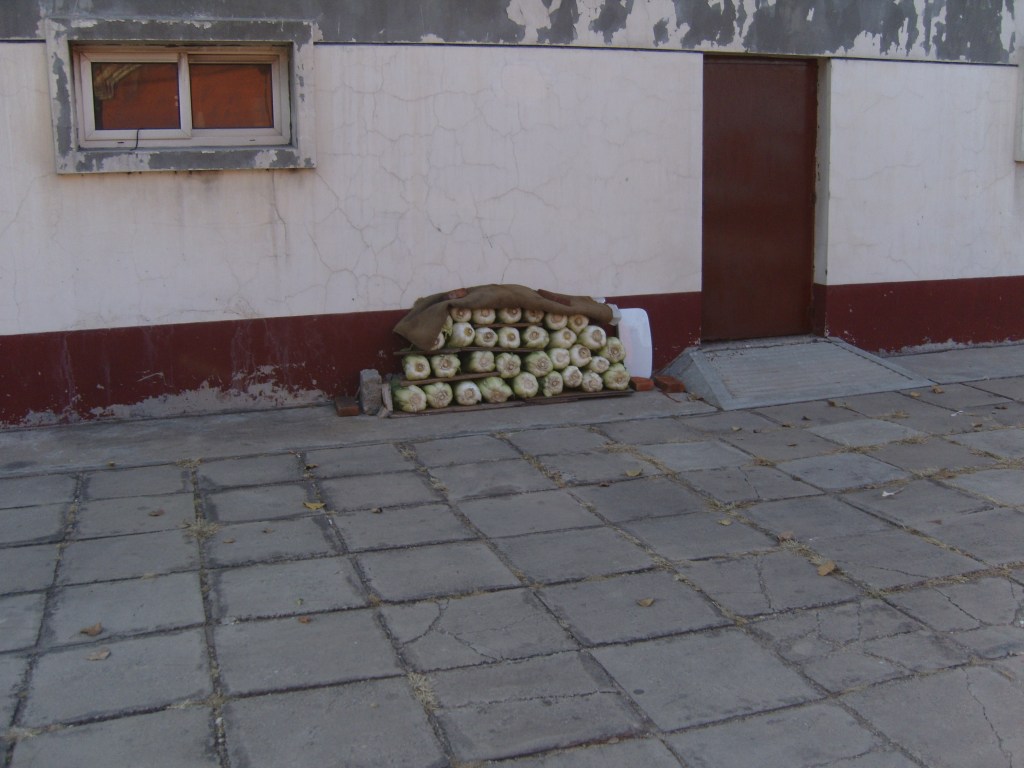
Not so long ago, October was an important month across China’s northeast.* As the weather turned, every family stored away a winter’s worth of baicai. They’d store it in the courtyards, or between windows and the window bars, or under their beds, peeling off the slowly-rotting layers to reveal untouched leaves underneath.
Li Wenzhong, the manager of Liaoning Provincial Restaurant in Beijing, remembers the process he’d go through every winter. “My parents would buy more than a half-ton of baicai at a time. The truck driver helped deliver it to our door, but the rest was up to us young boys. We dug a deep ditch in advance, maybe one meter across. Then we planted the baicai by the roots, and covered them with a think layer of soil. This way, we could store the baicai for the whole winter. It was a kind of natural refrigerator.”
That’s the way we did it in my hometown. Back when most Chinese people still lived in one-story houses, almost everyone had a little vegetable cellar in their courtyard. Our cellar was very deep, deep enough for an adult to stand upright. It was so cold in the winter that my mother never allowed me to go in—she would lock it from the outside to make sure. Every winter, we’d fill it with sacks of baicai. They were the staple of our meals, and winters wouldn’t have felt like winters without them.
There are so many ways to cook baicai… It can be fried, stewed, used in a salad, boiled in a soup, or—and this is one of my favorite ways—pickled in a big clay pot. Pickled baicai is known as suancai (酸菜, “sour cabbage” literally), and is one of the most important foods in Dongbei, northeastern China, as Dongbeiren (Northeastern Chinese people) say in their dialect:
“Where I’m from, we’re all addicted to eating suancai. Suancai is wicked good!”
Zài ǎn men nà gāda, ǎn men jiù ài chī suāncài, suāncài zéi lā de hào chī!
在俺们那旮嗒,俺们就爱吃酸菜,酸菜贼拉的好吃!
But I’m not from Dongbei, and I’d never heard of suancai before a pop song brought it to the nation’s attention. “All Dongbeiren Are Living Lei Fengs” – (《东北人都是活雷锋》Dōngběirén Dōu Shì Huó Léi Fēng) – a sassy hit, included the line “Cuihua, serve the suancai! (翠花,上酸菜! Cuìhuā, shàng suāncài!)” Cuihua, a common rural-Dongbei girl’s name, immediately became a byword for waitress, and suancai turned into the representative dish of Dongbei cuisine.
The taste of suancai is unforgettable. It’s sour, refreshing, and somewhat like sauerkraut, a dish I discovered when I first studied abroad, in Düsseldorf. But Manager Li pointed out the difference between the two. “German sauerkraut is made of regular cabbage—this is more suited to a salad. Chinese baicai, though, is strong enough for slow cooking.”
As the days get cooler, Li pickles both baicai and regular cabbage for himself. “The suancai sold in supermarkets is not good to eat. My homemade suancai is much better,” he said in his strong Dongbei accent. “Ever since I learned to cook, I’ve been picky about foods. I only like my own homemade suancai.”
To make your own homemade suancai, Li says you should wash and dry the leaves of 75kg of baicai individually, then cut them lengthwise. Spread them flat on the bottom of a large earthen jar, scattering 1.5kg of salt on top. Fill the jar with 15kg of clear cold water, cover the leaves with large stones, and seal the jar with plastic wrap. I know—it seems like a large amount, but if you’re going to eat it all winter, you better prepare well! Leave the baicai to ferment for a month. “After one month,” Li says, “it is OK to eat.”
Li takes his food seriously, and hesitated when I asked him what to pair it with. “We Dongbeiren like drinking alcohol with dinner and chatting happily with friends, and a pot of stewed pork with suancai is ideal for that situation. It tastes great. It’s the classic Dongbei dish.”
Manager Li’s head chef, Li Zhongzhi, is very shy and always smiling. “Manager Li is a better cook than I,” he said demurely. “You should interview him, not me.” But finally, after a battle of compliments, Chef Li agreed to teach me his recipe.
Li was the typical Dongbeiren: friendly, caring, reliable. I’d recommend you make as many Dongbei friends as you can. But before you do, why not try this traditional Dongbei dish first? I’m sure there’s a waitress named Cuihua who would be happy to take your order.
Ingredients
500g pickled baicai 酸菜 suāncài (aka Chinese sauerkraut, which is very mild – I haven’t tried it with European sauerkraut, which is more vinegary, but it might work after a rinse)
250g boneless marbled pork 五花肉 wǔhuāròu
30g ginger, minced 姜 jiāng
30g spring onion (US – scallion), chopped 葱 cōng
50g sweet potato noodles 粉条 fěntiáo
3g salt 盐 yán
5g chicken bouillon 鸡精 jījīng
10g vegetable oil 植物油 zhíwùyóu
Directions
Bring 500ml of water to a boil in a large stockpot. Add the meat, and half the ginger and scallions, and allow it to simmer for about 30 minutes, making sure to discard the foam floating on the surface of the soup.
Remove the pork from the soup with a slotted spoon. Reserve the broth, which you’ll need later, in a bowl. Chop the boiled marbled pork into 4cm slices.
Soak the pickled baicai in a bowl of clear cold water for about 5 minutes. Take it out and wash it carefully. Then chop it into 1cm slices.
Add the pork slices along with 600ml of water to the pot , quickly stirring for 1 minute. Then remove the pork again. Pour out the water and wash the pot carefully.
Add the remaining scallions and another 50ml of water to the pot, quickly stirring for a few seconds, then add the pork and the pickled baicai to the pot for 1 minute.
Add the soup that’s been used to boil the pork back to the pot, together with 3g of salt and 5g of chicken bouillon. Bring it to a boil, then reduce the heat, and simmer for about 30 minutes. Stir slowly, to keep the suancai leaves from sticking together.
Add the 50g sweet potato noodles and bring the mixture to a boil once again.
Serve!
*It still is. The photos below are of the teachers’ apartment blocks at Ocean College after a lorry delivered a load of baicai.

*Northeast in English is dongbei in Chinese, which is literally “east-north”.
Suancai – served in a jiǔjīng
(A a jiǔjīng is a pot on a spirit burner, like a fondue pot, placed on the table at mealtimes.)
Belly pork
Chinese sauerkraut (酸菜 suāncài)
Star aniseed
huajiao/majiao (two kinds of Sichuan pepper)
Chicken bouillon powder
Salt
(Optional: a dried red chilli, added with the aniseed)
Heat oil and add aniseed and huajiao/majiao. Add small thin slices of pork belly and stir-fry for about a minute, then add HOT water, a little chicken powder, salt (if required) and rinsed sauerkraut.
Bring to the boil and transfer to the jiûjīng.
Cover and place on the table.
Light the jiûjīng when the meal begins.
Wa wa cai 娃娃菜 Garlic and baby cabbage
Note: As is often the case with Chinese dishes, the ingredients and quantities below are not fixed. You can vary them to suit your own taste. This version is the most basic.
Ingredients
3 wa wa cai
10 cloves of garlic
Directions
Cut cabbage into four lengthways, wash, drain
Peel garlic and chop.
Boil water in a pot, add 1 tsp salt, and boil the cabbage until ‘al dente’ – not soft – and drain. Put on a warm plate.
Heat a little oil in a wok, add the garlic and cook until soft, reduce the heat and continue frying until it is golden brown. Remove garlic from the oil, and place on top of the cabbage.
Add soup stock to the remaining oil (shouldn’t be much, so you can add a little if needed), and add more salt or soy sauce if needed. Bring to a slow boil. Add a teaspoonful of cornflour mixed into a paste with cold water. Thicken slightly and pour onto the cabbage.
Note: you can prepare extra fried garlic in oil, which can be saved in a sealed container for use in salads, etc.
Wa wa cai 娃娃菜

This is my own version, where I tried to copy a local Dongbei-style restaurant, where it is absolutely delicious. I don’t use quite the same quantities; the restaurant uses more oil and may also use a little chilli oil and MSG, which I didn’t have at home, but might not be a bad idea.
Ingredients
3 wawacai
1 tablespoon of soybean (or peanut) oil
2 each red and green bird’s-eye chillies, seeded and chopped (optional)
A few bashed Sichuan peppercorns (optional – don’t use too many!)
1/2 of 1 Spring onion, chopped or sliced
A few slices of Twice-cooked pork 回鍋肉 – Huiguorou together with a tablespoonful of its sauce (if too thick, just add chicken stock to thin it out). Make sure some fat is included.
A sprinkle of sesame oil (optional)
Directions
Slice the cabbage lengthways and boil it until the leaves start to wilt. Drain.
Heat oil and add the chopped chillies (and Sichuan pepper, if liked), and spring onion. Stir-fry until the onion is soft, then add the pork and warm it through, then add its sauce (or stock).
Add the cabbage and cook until if softens (NOT TOO SOFT). Add the sesame oil, if using.
Place in a metal dish (small wok or Indian korai) and place the dish on a spirit burner or plate-warmer on the table to serve.
Note: If you don’t have any huiguorou, try a chopped-up slice of thin smoked bacon – or just leave it out. The meat is a flavouring, rather than an ingredient.
Chow Wawa cai
This version is from an Australian website http://www.gourmettraveller.com.au. I’ve never come across “Knorr chilli liquid seasoning”, but it’s optional anyway, and is probably just soy sauce with chilli oil. This looks a lot like my own version, although it uses uncooked pork belly and oyster sauce rather than Huiguorou (which I know my local restaurant uses). Here it is served as a side dish to barbecued lamb.

Ingredients
50 ml vegetable oil
50 g skinless pork belly, thinly sliced
15 g (about 5-6) red and green birds-eye chillies, thinly sliced into rings
600g baby Chinese cabbage, halved and cut lengthways into thin strips
1 tbs oyster sauce
1½ tsp soy sauce
1½ tsp Knorr chilli liquid seasoning (see above)
Directions
Heat oil in a large wok over high heat. Add pork and stir-fry until meat begins to curl (15 seconds). Add chillies, stir-fry until fragrant (30 seconds), then add cabbage and stir-fry until well coated (30 seconds).
Add oyster sauce, soy sauce, liquid seasoning and 1 tsp salt, stir-fry until wilted (2-3 minutes) and serve hot.
上汤娃娃菜 shàng tāng wá wá cài
Braised Baby Cabbage in Broth – Version 1
This dish is normally prepared with baby cabbage and preserved egg. Baby cabbage is specially grown in the mountains of Yunnan and it has a high vitamin content. It is best cooked in broth with preserved egg, red date and wolfberry. In Chinese medicine eating this dish helps to nourish the stomach and relieve internal heat.
baby cabbage 250g
1 preserved egg (an acquired taste – leave it out, if in doubt)
1 green pepper
1 bowl chicken broth
chopped spring onion
garlic slices
cornstarch mixed with a little water
Note: all the amounts can be varied according to personal taste.
Preparation
Wash and cut the baby cabbage into quarters. Put aside.
Wash and cut open the green pepper, discarding the seeds. Then cut into small cubes and put aside.
Shell the egg, then wash and dice.
Directions
Heat the wok over high heat. Add a little cooking oil and heat. Add the garlic slices and stir-fry for about 5 seconds until fragrant. Pour in the chicken stock and bring it to a boil. Add the cabbage and preserved egg and boil for 2-3 minutes until the cabbage quarters turn soft. Turn to low heat and remove the cabbage into a serving dish.
Turn to high heat, add the green pepper and boil for 1 minute. Add salt to taste and thicken the broth with cornstarch in cold water. Turn off the heat and pour the slightly thickened broth over the cabbage quarters. Sprinkle with chopped spring onion and serve.
上汤娃娃菜 (shàng tāng wá wá cài) Version 2
Ingredients
Wa Wa Cai
2 preserved eggs,
1 green pepper,
1 red pepper,
5 red dates (jujube),
1 tablespoon wolfberries (goji berries),
some garlic (to taste)
1 spring onion
3 cups of thin stock.
3 tablespoons edible oil,
1/4 tablespoon salt,
1/3 tablespoon chicken powder,
1/3 cup of starchy water.
Directions
Shell preserved eggs, cut into six pieces.
Wash red dates and wolfberries and then soak them in water for a while.
Wash and cut Wa Wa Cai into two pieces, hollow the green and red peppers and cut them into dice.
Heat 3 tablespoons edible oil, fry ginger and garlic slices and spring onion until fragrant, add green and red pepper dices in and stir-fry for a while. Then add 3 cups of thin soup, red dates and matrimony vine in and boil the mixture together.
Put preserved eggs and Wa Wa Cai into the boiling water, cover and cook on medium heat for about 5 minutes.
When Wa Wa Cai turns soft, add 1/4 tablespoon salt and 1/3 tablespoon chicken powder to flavour.
Add starch (cornflour, potato flour) in water to thicken.
Stir-Fried Shanghai Bok Choy with Ginger
Ingredients
1 piece ginger (2 inch, peeled)
3/4 lb shanghai bok choy (baby bok choy 5 to 8 heads)
1/4 cup chicken broth
1 tsp chinese cooking wine (preferably shaoxing wine or medium dry sherry)
1 tsp soy sauce
1/2 tsp cornflour
1/2 tsp salt
1/4 tsp sugar
1 tbsp vegetable oil
1/2 tsp sesame oil (asian)
seasoning
(special equipment: a rasp, 14 inch flat bottomed wok)
Directions
Cut half of ginger into very fine matchsticks (less than 1/8 inch thick; about 1 tablespoon) and reserve. Grate remaining ginger and squeeze pulp with your fingers to yield 1 teaspoon liquid, then discard pulp.
Remove any bruised or withered outer leaves from bok choy. Trim 1/8 inch from bottom of each bok choy, then cut each head into quarters. Wash bok choy in several changes of cold water and dry in a colander or salad spinner until dry to the touch.
Whisk together ginger juice, chicken broth, wine, soy sauce, cornflour, salt, and sugar in a small bowl until cornstarch is dissolved.
Heat wok over high heat until a bead of water vaporizes within 1 to 2 seconds of contact. Pour oil down side of wok, then swirl oil, tilting wok to coat sides. Add ginger matchsticks and stir-fry 5 seconds. Add bok choy and stir-fry until leaves are bright green and just limp, 1 to 2 minutes. Stir broth mixture, then pour into wok and stir-fry until vegetables are crisp-tender and sauce is slightly thickened, about 1 minute.
Remove from heat and drizzle with sesame oil, then stir to coat.
BBQ Pork With Shiitake and Bok Choy (or wawacai)
Ingredients
1 tablespoon plus 2 teaspoons peanut oil, in total
7 ounces shiitake mushrooms, quartered
1 pound pork tenderloin, cut into 1/4-inch-thick rounds
3 tablespoons Chinese hoisin sauce, divided
2 teaspoons finely grated peeled fresh ginger, in total
3/4 pound bok choy, halved lengthwise
1 cup grapefruit segments, plus 2 tablespoons juice
4 cups cooked rice (jasmine rice is good)
1 tablespoon chopped roasted peanuts
1/4 cup minced fresh chives
Directions
Heat wok or large skillet over medium-high heat; add 1 teaspoon oil and mushrooms; cook, stirring, about 3 minutes. Transfer to plate; cover.
Add 1 tablespoon oil to wok, and cook pork 2 minutes, turning often. Stir in 2 tablespoons hoisin and 1 teaspoon ginger. Cook, turning, 2 minutes or until cooked through. Transfer to plate; cover.
Add remaining 1 teaspoon oil to wok. Cook bok choy with remaining 1 teaspoon ginger, stirring often, 2 minutes or until almost tender. Add 1/4 cup water, grapefruit juice, and remaining 1 tablespoon hoisin; cook 2 minutes or until tender. Turn off heat.
Divide rice into 4 bowls, and top with pork, mushrooms, bok choy, and grapefruit. Sprinkle with peanuts and chives.
Chinese Cabbage (Bok Choy) and Pork Meatball Soup
Ingredients
1 1/2 lbs pork mince
4 chopped spring onions
1 teaspoon minced ginger
1 teaspoon sesame oil
2 large eggs
1 teaspoon salt
8 -10 cups chicken stock
10 slices of peeled fresh ginger
1 head bok choy, cut into 1 inch pieces
Directions
Combine pork, spring onion, ginger, sesame oil, eggs, and salt and shape into 35-40 meatballs.
Boil the chicken stock with the slices of fresh ginger.
Add the raw meatballs and simmer for 20 minutes.
Add the bok choy and simmer until done (NOT TOO SOFT), about 10 more minutes.
Stir Fried Baby Bok Choy (or wawacai)
Ingredients
1 1/2 pounds baby bok choy
2 tablespoons peanut oil
1 (1/4-inch) piece fresh ginger, minced (about 1 teaspoon)
2 spring onions (white and green parts), thinly sliced
4 cloves garlic, thinly sliced
1 teaspoon coarse sea or kosher salt
1 teaspoon sugar
1/8 teaspoon ground white pepper
Directions
Trim 1/4 inch from bottom of each head of bok choy. Slice bok choy crosswise into 1/2-inch-thick slices. Wash bok choy in several changes of cold water and dry in colander or salad spinner until dry to touch.
In wok or large sauté pan over moderately high heat, heat oil until hot but not smoking. Add ginger, scallions, and garlic and stir-fry until aromatic, about 15 seconds. Add bok choy, salt, sugar, and pepper and stir-fry 1 minute. Add 1 tablespoon water, cover, and cook until wilted, about 30 seconds. Uncover, stir-fry 5 seconds, then cover again, turn off flame, and let steam in residual heat until just tender, about 30 seconds more.
Serve immediately.
Wa wa cai with Hoisin sauce
Adapted from a recipe in The Washington Post, March 3, 2010.
Ingredients
1 pound (16 to 18) wawacai, rinsed (see Note)1 tablespoon olive oil
4 or 5 spring onion, white and light-green parts, cut crosswise into thin slices
1-inch piece peeled ginger root, finely chopped or minced
2 tablespoons Shaoxing wine
200-250ml chicken broth
2 teaspoons toasted sesame oil, or more to taste
1/2 teaspoon sugar, or more to taste
2 tablespoons hoisin sauce
1 tablespoon cornstarch
2 tablespoons cold water
1 to 2 tablespoons toasted sesame seeds, for garnish (optional; see NOTE)
Directions:
Position a steamer over several inches of water in a saucepan or wok and heat over medium-high heat. When the water comes to a boil, add the wawacai, cover and steam for 3 to 4 minutes, until they are brightly colored and just tender. You will probably need to do that in batches so the wawacai are not crowded in the steamer. As the wawacai are done, transfer them to a large platter, arranging them in a single layer.
Heat the olive oil in a wok over medium heat. Add the spring onion and ginger; cook for 1 to 2 minutes, stirring, until the spring onion starts to soften. Add the wine and cook for 30 seconds. Add the broth, toasted sesame oil, sugar and hoisin sauce. Stir to combine, and pour into to a boil.
Blend the cornstarch and water in a small bowl, then add the mixture to the wok. Once the mixture returns to the boil, cook for 1- 2 minutes, until it has thickened. Remove from the heat. Taste, and adjust the seasoning.
Pour the sauce over the steamed wawacai. Garnish with sesame seeds to taste, if liked. Serve hot or at room temperature.
NOTE: Toast the sesame seeds in a dry pan over medium heat for 3 to 5 minutes, stirring or shaking them frequently, just until fragrant and lightly browned.
 Personal homesite