I always enjoyed the fish dishes in China, especially in Qinhuangdao (by the sea). One day, having mentioned this to some colleagues at the university, they arranged a special fish banquet at the restaurant belonging to one of their friends. There, we were presented with six fish, each cooked in a different way (plus some side dishes, of course).
The best fish dishes are served in restaurants specialising in fish and seafood, and often there are tanks full of fish swimming around, from which the customer can choose the kind and size of fish – in some, it is even possible to watch the preparation and cooking.
I’ll only give a few recipes here (mostly, but not only, from my former student and friend in Qinhuangdao, Wu Jianglei). If you would like to see more, this is a good website.
Sichuan Boiled Fish (Shuizhuyu, 水煮鱼)
Sichuan Boiled Fish, or shui zhu yu, is a very popular dish throughout China, especially in Sichuan speciality restaurants. It can be quite oily, with lots of Sichuan peppercorns, and dried red chillies, all used to flavour the delicate fresh fish slices. It should be chilli hot, but the whole spices are not meant to be eaten.
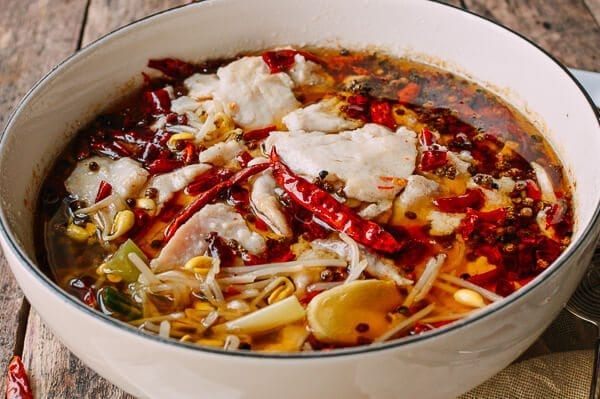
Version 1
Ingredients
500g of fish fillets (such as tilapia, catfish, flounder, carp, or snakehead)
3/4 teaspoon salt (plus more salt to taste)
½ teaspoon ground white pepper (divided)
2 tablespoons Shaoxing (Xiaoxing)wine (divided)
1 egg white
1½ tablespoons cornflour
1 tablespoon vegetable oil (plus an additional ½ to ¾ cups)
3 cups chicken stock
2 cups water
5 slices ginger
3 cloves garlic (thinly sliced)
2 spring onions (cut into 2-inch lengths)
3/4 pound soybean sprouts
15 grams dried red chili peppers (1/2 cup, de-seeded and chopped)
10 grams green Sichuan peppercorns (ma jiao 麻椒, 3 tablespoons)
Directions
Cut the fish into ¼-inch thick slices at a 45-degree angle. The aim is to get pieces of fish with a lot of surface area, as they’ll shrink once cooked.
Next, marinate the fish.
Add 3/4 teaspoon salt, ¼ teaspoon ground white pepper, and 1 tablespoon Shaoxing wine. Mix everything well (best done by hand). Then, add the egg white and mix, followed by 1½ tablespoons of cornflour. Mix until the marinade starts to feel a bit slimy. Finally, drizzle 1 tablespoon of oil over the top – there’s no need to mix it in, just drizzle it over the surface. Put the fish and marinade in the fridge, and leave for about 20 minutes.
The active cooking time takes less than 10 minutes, so make sure the rest of the ingredients are prepared while the fish is marinating, and that you’re ready to eat as soon as the dish is ready, because it really is best served immediately.
In a wok over high heat, add the chicken stock, water, ginger, garlic, spring onions, ¼ teaspoon of white pepper, and 1 tablespoon of Shaoxing wine. Bring to a boil, and add salt to taste. Next, add the bean sprouts, and bring to a boil once more. Cook for one minute, turn down the heat, and using a fine-meshed strainer, or large slotted spoon, scoop all the solids out of the soup and transfer to a heat-proof serving dish. It’s very important that the serving dish is heat-proof, as you’ll be pouring very hot oil into it later.
Now, in a small pot, slowly heat up ½ – ¾ cup oil. It doesn’t have to be exact, but you should use at least ½ cup. To test whether the oil is the correct temperature, dip a wooden/bamboo chopstick into the oil and look for small bubbles forming around it, but no smoke. If the oil is smoking, it’s too hot!
While the oil is heating, bring the soup back to a boil, then turn the heat down to low. Place your fish, one piece at a time, into the soup. Once all the fish is in the soup, turn up the heat and bring everything to a boil. Once boiling, immediately pour everything (fish and soup) on top of the vegetables in the serving bowl.
Quickly sprinkle the dried chillies and the green Sichuan peppercorns evenly over the fish, and pour the heated oil evenly over everything. The oil should be hot enough to sizzle the chillies and the peppercorns, but not hot enough to burn the spices. Serve immediately!
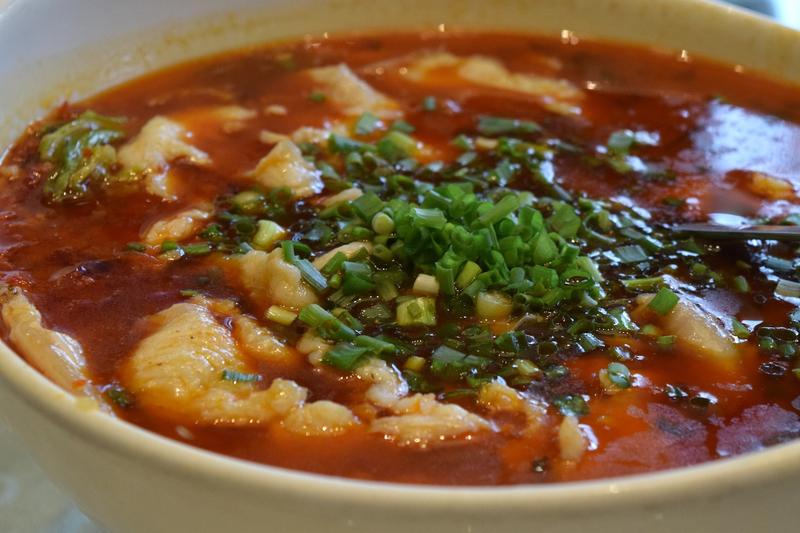
Version 2
Ingredients
One fresh fish around 1000g to 1500g
Marinade
1 tablespoon cornflour
1 teaspoon salt
1 tablespoon Shaoxing cooking wine
Other ingredients
5 garlic cloves
2 spring onion, separate white and green part
2 cups of Shitake mushrooms , you can choose other vegetables you like for example cucumber or bean sprouts
1 inch root ginger , peeled and sliced
3 star anise
1 large cassia bark , break into small sections
2 tsao-kuo (“false cardamom”, black cardamom), optional
1 teaspoon Sichuan peppercorn
10 dried chili red pepper
2 tablespoon cooking oil
1 tablespoon doubanjiang
2 teaspoons dou-chi (fermented black beans)
pinch of salt if needed
Water as needed
1/2 tablespoon sesame seeds for garnish
Instructions
– Cut the fish meat into thin slices and chop the bones into sections.
– Put all the bone section and fish slices in large bowl; add cooking wine, cornflour and salt. Mix thoroughly and set aside to marinade about 15~30 minutes.
– Boil some water in a wok and cook mushrooms or any other vegetables (e.g.cabbage or other leafy vegetable, chopped into bite size pieces). Then lay the vegetables in the bottom of your serving dish
– Heat 1 tablespoon of vegetable oil in a wok, add star anise, cassia bark and tsao ko to stir fry for around 2 minutes until you can smell the aroma. Discard the cassia bark.
– Add garlic, ginger and white part of spring onion and stir-fry for about 1 minute, then add half of the Sichuan peppercorns and half the dried chilli peppers and stir-fry until smell fragrant.
– Add doubanjiang and dou-chi and stir-fry for 1 minute until fragrant.
– Pour water (around 3 cups) into wok and turn down the heat after the water boils to simmer for 15 minutes and then add 2 teaspoons of salt.
– Pick the bone sections out of the marinade and cook them first for around 1 minute, then add the thin slices of fish to cook until they become white.
– Transfer all the contents to the serving dish. Garnish with some chopped spring onion and sesame seeds.
– Heat about 2 teaspoons cooking oil in a wok and add the remaining Sichuan peppercorns and chillies.
– Pour the hot oil with the Sichuan peppercorns and chillies evenly over the surface of the dish.
– Garnish with another layer of spring onions.
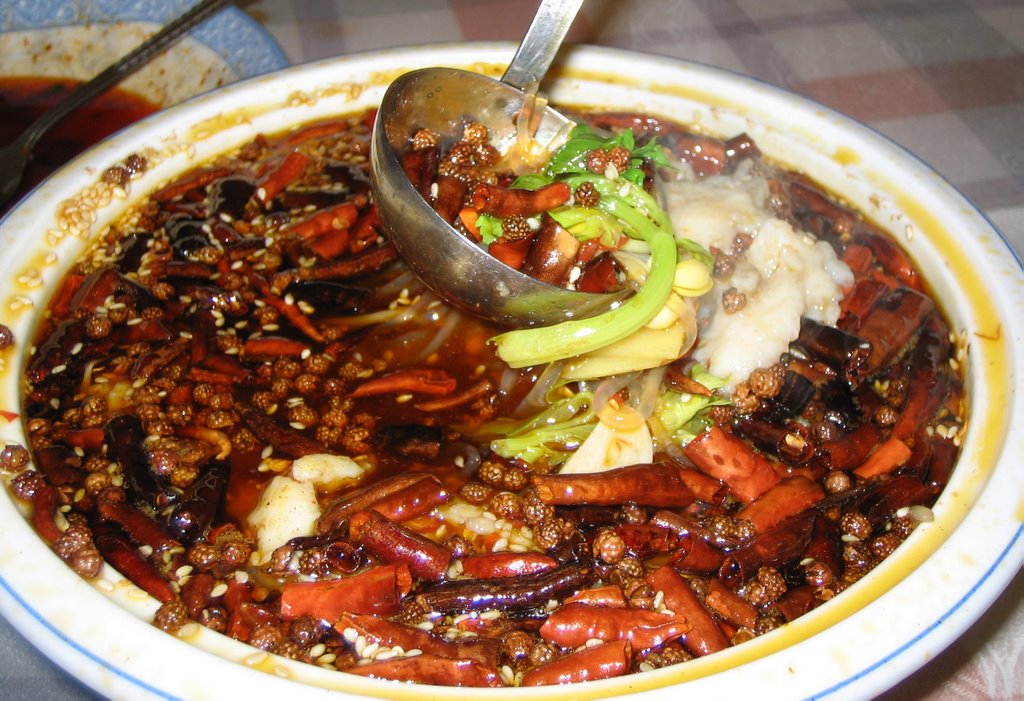
Sichuan Spicy Fish Soup

Servings 4, Author jeanetteshealthyliving.com (slightly modified by me)
Ingredients
1 pound white firm flesh fish fillet
Fish Marinade
1 egg white
1/8 teaspoon salt
2 teaspoons rice wine
1 tablespoon cornflour
Soup
2 tablespoons grapeseed oil
1 tablespoon Sichuan hot bean sauce
One 1″ piece of ginger peeled and sliced
4 cloves garlic sliced
1 spring onion cut into 1/2″ pieces
1 tablespoon Sichuan peppercorns
1/4 cup Sichuan dried red chili peppers
1 tablespoon rice wine
2 teaspoons soy sauce
2 cups fish or chicken stock
2 celery stalks sliced
1 cup napa or Chinese cabbage torn up
Instructions
Cut fish into 2″ pieces. Mix Fish Marinade ingredients and toss well with fish fillet. Set aside to marinade for 20 minutes.
Heat oil in a large pot. Add hot bean sauce and stir until fragrant, about 1 minute. Add ginger, garlic, half of scallions, Sichuan peppercorns, and dried chili peppers. Cook until fragrant, about 1-2 minutes, being careful not to burn the peppercorns or chili peppers. Add rice wine and soy sauce and stir another minute. Add stock and bring to a boil.
Place celery and napa cabbage in a clay casserole. Lay marinated fish on top.
Pour soup on top of fish. Bring to a boil, then reduce heat and simmer, covered, for 15 minutes until fish is cooked through.
Serve over steamed (brown or white) rice.
Recipe Notes
This is spicy! Reduce the amount of hot chili peppers and Sichuan peppercorns if you like, but for the full effect, I highly recommend using as much as the recipe states.
If you want to bulk out the soup, or turn it into a stew, you could add some firm tofu, cut into bitesize pieces, once you have turned the heat to a simmer.
Sichuan-style Sour Cabbage Fish
(from Wu Jianglei)
This dish uses a special type of cabbage from Sichuan Province, but it’s not unlike sauerkraut, which could be rinsed and drained, then used as a substitute.
Whole fish, fins trimmed, scaled, gutted and washed. If the fish is too big for the wok, it can be cut crosswise into large pieces.
Sichuan pickled cabbage
Leek, garlic, ginger, all sliced.
Chicken powder
1 star anise
Chinese cooking wine
Peanut oil
Place some leek, garlic, ginger and salt inside the fish and rub more on the outside, together with some cooking wine. Leave to marinate for about 15 minutes.
Fry the fish on both sides in hot oil, then remove it from the oil.
In fresh oil, stir-fry half the remaining leek, garlic, and ginger until aromatic, then add the drained pickled cabbage. Cook for a while. Do not add salt (there’s plenty in the cabbage).
Add chicken powder and water, then the rest of the leek, garlic, and ginger, plus the star anise, then return the fish to the pan with a little wine.
Bring to the boil, cover and cook on medium-high heat for about 7 minutes. Serve everything in a large dish. The sauce is very good with rice; if there is too much, it can also be used to make soup.
Red-cooked fish (Hongshao yu)
(from Wu Jianglei)
Whole flat-fish
Ginger
Garlic
Leek
Wine
Salt
Chicken powder
Soy sauce
Vinegar
Hongshao sauce
Score the fish on both sides and marinate with a little wine, finely chopped garlic and ginger, sliced leek, salt, and chicken powder for about 20-30 minutes.
Heat oil and fry fish for about half a minute on both sides.
Remove the fish from the oil.
Fry more leek, garlic, and ginger in fresh oil until fragrant.
Add a little soy-sauce and vinegar, plus Hongshao sauce (more than the soy and vinegar, but not a huge amount), add water and stir.
Add chicken powder and salt. When the water boils, put the fish in and cover. Cook on high heat for 3-5 minutes.
Check the fish is cooked (the tail should pull off easily) and serve with some of the sauce poured over.
Simple Home-style Braised Fish
(from Wu Jianglei)
This doesn’t sound very special, but it is!
It is a “home-cooking” recipe – I never saw it in a restaurant. The soybean paste is the key ingredient, just don’t overdo it.
Fry (scaled, trimmed, gutted and washed) whole fish in hot oil for a few minutes until golden, remove from oil and drain.
Heat fresh oil in a wok. Add (1 whole) star anise, (2-5) dried red chillies and Sichuan pepper (optional). Stir a few seconds, then add coarsely chopped spring onion with sliced ginger and garlic. Fry until aromatic, then add soybean paste and fry briefly.
Add a few teaspoons of soy sauce, some salt and water.
Put in the fish, partly cover and stew for about half an hour.
Spicy Fish
(from Wu Jianglei)
A whole fish (scaled, trimmed, gutted and washed)
Ginger
Garlic
Onion
Dried red chillies (a lot)
Heat oil in a wok and add the onion, ginger, garlic, and a handful of broken dried red chillies.
When lightly browned, add water.
When the water is boiling, add the fish and cook for about 15 minutes.
Remove the fish and put it on a plate.
Heat more oil in a wok and add more dried red chillies.
Cook until they change colour, then pour over the fish.
(This is the basic recipe – you could experiment by adding additional whole spices, e.g. Sichuan peppercorns and star anise. Salt or soy sauce could also be added with the water, but try it without first.)
 Personal homesite